Pair Software
The hidden cost of per-user pricing
Why software pricing hasn’t caught up with how modern operations actually work
Modern operations don’t treat every user the same - and pricing shouldn’t either.
In reality, systems are used in two
fundamentally different ways:
What is Participant-Based Economics?
Participant-Based Economics is a pricing model where software cost is based on how people interact with a system - separating those who run it from those who participate in it.
Most software pricing answers one question: How many users do you have?
But modern operations don’t scale like that.
With traditional
Per-User pricing
As your team grows:
- more people need access
- more workflows involve different participants
- more coordination happens across systems
But cost increases linearly with users - not with complexity or value.
Growth becomes more expensive - even when the work becomes more efficient.
This is the “success tax”.
Why Per-Action pricing doesn’t fix it
Some platforms try to fix this by charging per action or event.
But this creates a different problem:
- costs become unpredictable
- pricing becomes harder to forecast
- meaningful usage feels penalised
You don’t solve the misalignment.
You just move it somewhere else.
Pair - A different approach
We don’t price based on users or actions.
We price based on how the system is actually used.
Because not everyone uses it in the same way.
Pair - A different approach
- We don’t price based on users or actions.
- We price based on how the system is actually used.
Because not everyone uses it
in the same way.
With traditional
Per-User pricing
As your team grows:
- more people need access
- more workflows involve different participants
- more coordination happens across systems
But cost increases linearly with users - not with complexity or value.
This creates a structural problem - often called a “success tax”: The more your operation scales, the more you pay - regardless of how efficiently it runs.
Cost increases whether or not value does.
Why Per-Action pricing doesn’t fix it
Some platforms try to solve this by charging per action, task, or event.While this removes the user problem, it creates a new one:
- costs become unpredictable
- pricing becomes harder to forecast
- meaningful usage feels penalised
You end up trading one misalignment for another.
At Pair, we use a different model: Participant-Based Economics
Modern operations don’t treat every user the same - and pricing shouldn’t either.
In reality, systems are used in two
fundamentally different ways:
A pricing model based on how work actually happens
In practice, systems are used in two ways:
Running the system (operators)
A small group managing workflows, coordinating operations, and controlling how work happens.
Participating in the system (active participants)
A larger group interacting with tasks, workflows, or endpoints - without needing full system access.
Not everyone uses the
system in the same way.
So not everyone should
be priced the
same way.
Modern operations don’t treat every user the same - and pricing shouldn’t either.
In reality, systems are used in two
fundamentally different ways:
What this looks like in practice
A typical operation might have:
- 5 people running the system
- 50–100 people interacting with it
Traditional pricing treats them all the same.
Participant-Based Economics doesn’t.
Not everyone uses the
system in the same way.
So not everyone should
be priced the
same way.
Modern operations don’t treat every user the same - and pricing shouldn’t either.
In reality, systems are used in two
fundamentally different ways:
What this looks like in practice
A typical operation might have:
- 5 people running the system
- 50–100 people interacting with it
Traditional pricing treats them all the same.
Participant-Based Economics doesn’t.
What happens when pricing matches usage
For many businesses, this goes further.
When participation is separated from control, software cost can be tied more directly to the work being delivered - making it easier to manage margin and align cost with revenue.
Participation can scale without cost scaling linearly
Inactive users don’t create unnecessary cost
Access reflects real usage, not assumptions
Coordination overhead reduces — and teams start to claim back time
This isn’t just about cost - it’s about time
Most operational friction comes from:
- manual coordination
- managing access and users
- fragmented workflows across people and systems
When systems are structured around how work actually flows:
- coordination reduces
- workflows run more smoothly
- and teams get time back
How the models compare
Here’s how Participant-Based Economics compares to traditional models:
Per-user pricing
- Pay for every user
- Cost scales with headcount
- Inefficient for distributed teams
Per-action pricing
- Pay for every interaction
- Costs are unpredictable
- Harder to control
Usage-based
participation (Pair)
- Pay for operators + active usage
- Cost reflects real system use
- Scales with operations, not headcount
See how this works for your operation
Less noise.
More control.
This model is designed to be simple in use - even if the thinking behind it is different.
Common questions about software pricing models
Answers to questions we hear often.
What is Participant-Based Economics?
A pricing model where cost is based on how people interact with a system - separating operators from participants so pricing scales with real usage, not total users.
What is the “success tax” in software pricing?
The effect of per-user pricing where costs increase as teams grow, regardless of whether system complexity or value increases.
Why do most SaaS tools charge per user?
Because early sofware was designed for small, fixed teams where every user needed full acces.
What's wrong with per-user pricing?
It doesn’t reflect modern operations where many people interact with systems without needing full access.
What is usage-based pricing in software?
A model where cost reflects how the system is used - not just how many users exist.
Is usage-based pricing cheaper?
For operational businesses with large or variable participation, it is often more efficient and predictable.
Pair Software
Want to see if this model fits your operation?
Explore pricing or book a quick call - we’ll show you how this works in practice.
FEATURES
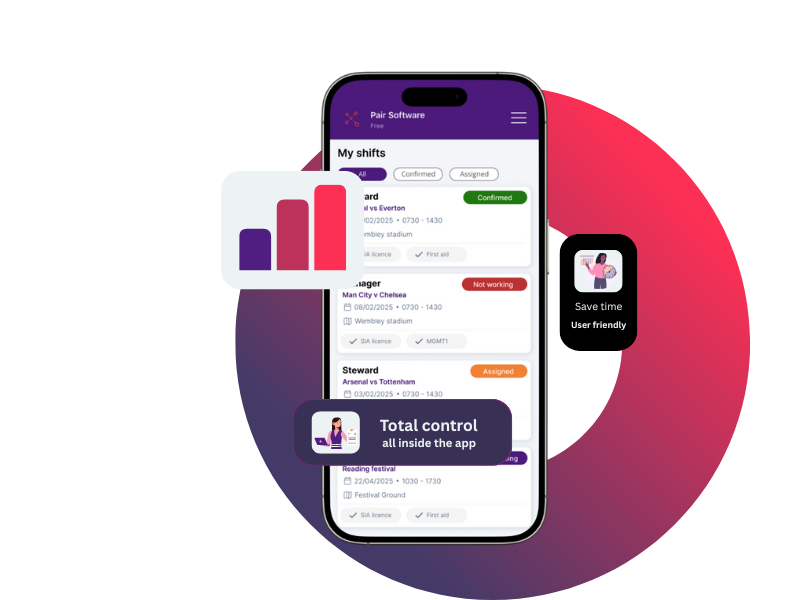
Bookings, staff and client management system
Prevent customer drop off
Simplify sign-ups for sessions and memberships. Attract customers with feature rich chat bots, prevent double bookings, and automate refunds for seamless management.
Manage staff onboarding and rosters
Turn bookings into ready-to-go shifts. No guesswork, no chasing, no wasted payroll. Auto-generates shifts from bookingsFreelancers get notified instantly - no chasing
Track hours, incidents, and attendance with one click.
Try a demo today
Get in touch today to request a demo.
See for yourself how Pair can help streamline your business and fuel your growth.